
Description
Within the context of the IEC roadmap a micro-grid is defined as follows: “group of interconnected loads and distributed energy resources (DER) with clearly defined electrical boundaries that acts as a single controllable entity with respect to the grid and can connect and disconnect from the grid to enable it to operate in both grid connected or island mode.”
Based on local DERs and micro-grid primary devices, a micro-grid system needs to maintain its stability, voltage, frequency, and reliability.
While in the grid connected mode, a micro-grid system may interface to an ADMS (Advanced Distribution Management System) and/or aggregator/ energy provider to perform various grid support functions such as:
a) Peak Management (Demand charge management);
b) Flexible tariffs (time of use);
c) Responsive reserves;
d) Ancillary Services (frequency support, Demand response;
e) Grid Voltage Support (Volt Var control, Volt Watt controlVA);
f) Backup Emergency Power.
While an islandable or islanded micro-grid system may be called on to perform the following functions:
1) Islanding on requests;
2) Islanding on emergency;
3) Grid Synchronizing and (re-) Connection;
4) Balancing Supply and Demand;
5) Black Start in islanding mode;
6) Network Configuration;
7) Active/Reactive Power Compensation/Voltage Control;
8) Economic Dispatch;
9) Load Control.
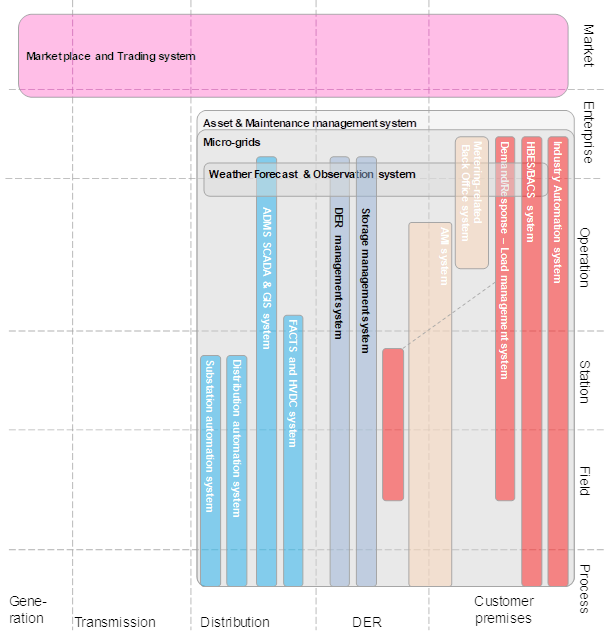
From a domain perspective, micro-grids may cover three main domains: Distribution, DER and Customer premises, and then encompass systems from these same domains. The Figure below outlines the components, subsystems, and interfaces which make up a micro-grid system. With these interfaces defined, a set of standards can be identified.
Available standards
The standards listed below are available on IEC webstore.
|
Layer |
Standard |
Comments |
|
Information, Communication |
IEC 61850-90-23 |
Communication networks and systems for power utility automation - Part 90-23: Use of IEC 61850 for microgrids systems |
|
Component |
IEC 62898-1 |
Microgrids - Part 1: Guidelines for microgrid projects planning and specification |
|
Component |
IEC 62898-2 |
Microgrids - Part 2: Guidelines for operation |
|
Component |
IEC 62898-3-1 |
Microgrids - Part 3-1: Technical requirements - Protection and dynamic control |
|
Component |
IEC 62898-3-2 |
Microgrids – Part 3-2: Technical requirements - Energy management systems |
|
Component |
IEC 62898-3-3 |
Microgrids - Part 3-3: Technical requirements – Self-regulation of dispatchable loads |
|
Component |
IEC 62898-3-4 |
Microgrids – Part 3-4: Technical requirements – Monitoring and Control systems |
|
Function |
IEC 62898-4 |
Microgrids: Part 4 - Use cases. |
|
Component |
IEC 62786-1 |
Distributed energy resources connection with the grid - Part 1: General requirements |
|
Component |
IEC 62786-3 |
Distributed energy resources connection with the grid - Part 3: Additional requirements for stationary battery energy storage system |
|
Component |
IEC 62786-41 |
Distributed energy resources connection with the grid - Part 41: Requirements for frequency measurement used to control distributed energy resources (DER) and loads |
Coming standards
|
Layer |
Standard |
Comments |
|
Component |
IEC 62898-3-5 |
Microgrids – Technical requirements – Testing for Microgrid Monitoring, Control, and Energy Management Systems |
|
Component |
IEC 62898-3-6 |
Microgrids – Technical Requirements – Emergency supply of microgrids by electric vehicles |
|
Communication, Information |
IEC 63402-1 |
Energy Efficiency Systems - Smart Grid - Customer Energy Management Systems – General Requirements and Architecture |
|
Communication, Information |
IEC 63402-2-1 |
Energy Efficiency Systems - Smart Grid - Customer Energy Management Systems - Interface between the Energy Management Gateway and BEM / CEM - Data model and messaging |
|
Communication, Information |
IEC 63402-2-2 |
Energy efficiency systems - Smart grid - Customer energy management systems - Interface between the home/building CEM and resource manager(s) - Data model and messaging |
In order not to duplicate information already depicted in this Smart Energy Roadmap, the best is to rely on the already described mapping of the underlying systems.