
The purpose of this document is to depict a comprehensive standardisation landscape of the interfaces between the main grid stakeholders and the “distribution” grid users, grid users comprising DERs and customer premises.
A first objective of this document is to consider the main “physical” and “logical” interactions (i.e. through wires/functions – power and/or communication) between grid users and the grid stakeholders, both from an electrical standpoint and from a data standpoint. Then for each interaction types, the document presents the associated standardisation landscape.
A second objective is to depict, as well, the interactions between the grid stakeholders manipulating grid users related data, themselves. Providing a seamless vision of the management of these data is becoming of highest priority.
Therefore this document also depicts the standardization landscape associated to the management of users-related data.
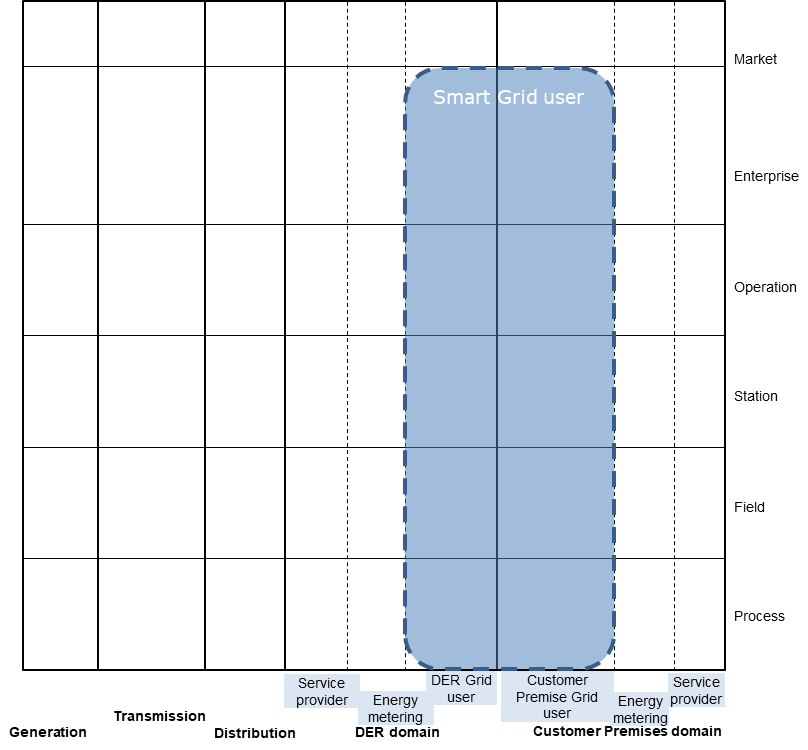
A “Distribution Smart Grid user” positionned on the SGAM
The document focuses on Distribution Grid users, excluding as such “bulk generation” grid users and “transmission connected grid users”, the main reason being that the main breakthrough resulting
from the introduction of Distributed Energy resources affects mostly the Distribution Grid users.


The main Smart Grid users interactions
This document identified 10 types of interactions (numbers 1 to 10 in the diagram on the left).
and “10” reflecting the interaction between grid users and market places
The integration of Electrical Vehicles (EVs) on the landscape introduces some needed refinements of the architecture and new types of interactions, especially due to the fact that EVs are by essence mobile
The current edition of this document mostly focuses on establishing the standardisation landscape for the considered domain, including the IEC entities involved in producing reports, technical specifications and standards related to it.
From this assessment a first set of recommendations is issued related to the way IEC addresses this scope.
Cybersecurity is fully part of the considered interfaces, however this aspect is not treated in this document but fully addressed in the IEC Technology Report “Cyber security and resilience guidelines for the smart energy operational environment”.