
Description
The ongoing changes in the electrical energy infrastructure will also offer new opportunities for industrial automation. Energy efficiency and the minimization of a plant‘s impact on the environment are common goals across the industry. While designers will tend to specify low power consumption devices and equipment, overall plant efficiency and environmental stewardship will continue to dominate design decisions. In addition, the availability of the Smart Grid will allow industry to better match how it generates and uses electrical energy, resulting in reduced costs and impacts on the environment while enhancing efficiency, safety and production quality.
The Smart Grid promises to make available to industry the ability to better access dynamic energy tariffs and to better co-ordinate electricity consumption and in some cases electricity supply to the grid. Many industries generate significant amounts of electricity internally, for example using co-generation equipment, and industry world-wide consumes about 40 % of the total electricity generated by traditional electric utilities. The availability of “smarter” interfaces to the grid will enable a better management of industrial energy resources by providing industrial process automation the necessary added flexibility. This can be used by industry to reduce energy costs by aligning consumption to periods when energy prices are low and to create new revenue sources by selling energy to the grid.
The objective of this section is not then to provide a complete overview of industrial automation systems, but to focus on their interaction with the Smart Grids and identify the standards needed to allow industrial facilities, and the industrial automation systems within such industrial facilities, to communicate with the Smart Grid for the purpose of planning, negotiating, and managing the flow of electrical power and related information between them.
It is recognized that a wide range of industrial facilities will interface with the Smart Grid. This section addresses arrangements where the industrial facility or a facility-contracted intermediate party, remains responsible for the operation of facility internal energy resources. For these industries, energy arrangements are primarily made to support internal production (manufacturing) by the facility. In some cases a facility may enter into agreements with an intermediate party to take responsibility for management of their internal energy resources and this party would then implement the interface to the Smart Grid. Such parties would understand the consequences of such control and may rely on a detailed understanding of internal facility operations.
Other arrangements will exist, for example where the industrial facility offers energy generation or storage resources primarily for the benefit of the grid, allocates responsibility for the operation of these resources to the grid, and the grid takes responsibility, and assumes any corresponding liability, for such operation. These latter arrangements were addressed are addressed in the section on DER management system.
The industrial arrangements identified in this section have to address the unique requirements which can be summarized as follows.
Many industries have significant options for production scheduling given sufficient notice, but they can seldom respond to unplanned energy shortages by simply reducing their short term demand across the board. Unlike typical consumer applications where loads can be reduced, for example by acting on heating, ventilation, cooling and lighting, it is often critical that energy supply be kept in planned conditions once industrial production has started to ensure that production quality, plant safety and security are maintained. Some types or phases of production, once started, cannot be stopped immediately without damage to equipment. Thus the criteria used to respond to unplanned demand events and energy fluctuations have to differ from that of, for example, home and building automation, so that the consequences of unplanned changes can be factored into operations and into the design of the industrial plant itself.
Some industrial facilities can postpone or reduce production at times of predicted energy shortage if given sufficient notice. Industrial facilities can be designed to adjust the production quantity, for example, through parallelism, and the scheduling of activities across shifts. Industrial facilities could choose to reduce production if the current energy cost makes the incremental cost of production exceed the incremental product’s value. Industry could choose to operate energy intensive operations during periods when energy costs are low. Simple time-of-day pricing would not always provide the flexibility needed to allow full exploitation of the scheduling.
Many larger industries have significant internal energy generation and/or storage capabilities. A plant with in-house hydroelectric generation could draw energy from the grid during off-peak times and use the corresponding saved hydroelectric power to supply energy to the grid at peak times, thus providing the equivalent of pumped energy storage. Plants with co-generation facilities could also assist the grid in meeting normal and emergency energy demands. These situations can only be addressed if the Grid operator and Industry can dynamically negotiate and plan such arrangements on a short-term basis.
Notwithstanding the above opportunities, it is emphasized that the owner of the industrial facility will expect, and will demand, that they retain full responsibility for the operation of all of their equipment, including energy generation, use and storage equipment, within the facility. Direct control of energy resources within the facility has to be retained by the facility operator to ensure that all safety, production quality and environmental targets are met. Seldom will the external electrical grid entity desire to accept the liability associated with the direct control of facility equipment.
Available standards
The standards listed below are available on IEC webstore.
|
Layer |
Standard |
Title and comments |
|
General |
IEC 62264 series |
Enterprise-control system integration (defines Architecture) |
|
General |
IEC TR 62794 |
Industrial-process measurement, control and automation – Reference model for representation of production facilities (digital factory) |
|
Business, Function |
IEC 61508 series |
Functional safety of electrical/electronic/programmable electronic safety-related systems |
|
Business, Function |
IEC 61511 series |
Functional safety – Safety instrumented systems for the process industry sector |
|
Business, Function, Information, Communications, process |
IEC 62443 series |
Industrial communication networks – Network and system security |
|
Information, Communication |
IEC TS 62872 |
Industrial-process measurement, control and automation system interface between industrial facilities and the smart grid |
|
Communication |
IEC 61158 series |
Industrial communication networks – Fieldbus specifications |
|
Communication |
IEC 61784 series |
Industrial communication networks – Profiles |
|
Information, Communication |
IEC 61588 |
Precision clock synchronization protocol for networked measurement and control systems |
|
Component |
IEC 61918 |
Installation of communication networks – Installation of communication networks in industrial premises |
|
Function, Information |
IEC 61499 series |
Function blocks |
|
Function, Information |
IEC 61804 series |
Function blocks (FB) for process control |
|
Information, Communication |
IEC 62541 series |
OPC unified architecture |
|
Information Communication |
IEC PAS 62746-10-1 |
Systems interface between customer energy management system and the power management system – Part 10-1: Open Automated Demand Response (OpenADR 2.0b Profile Specification) |
|
Communication, Information |
IEC TR 62746-2 |
Systems interface between customer energy management system and the power management system – Part 2: Use cases and requirements |
|
Communication, Information |
IEC TS 62746-3 |
Systems interface between customer energy management system and the power management system – Part 3: Architecture |
|
Information, Communication |
IEC TR 62939-1 |
Smart grid user interface |
|
Information, Communication |
(refer to 4.9.13.5) |
refer to the DR management systems depicted in 4.9.13 |
|
Information, Communication |
(refer to 4.9.8.6) |
refer to the DER system depicted in 4.9.8 |
|
Information, Communication |
(refer to 4.9.10.5) |
refer to the AMI system depicted in 4.9.9 |
|
Business, Function |
IEC TR 62685 |
Industrial communication networks – Profiles – Assessment guideline for safety devices using IEC 61784-3 functional safety communication profiles (FSCPs) |
|
Business, Function |
IEC TR 62837 |
Energy efficiency through automation systems |
|
Communication |
IEC 62439 series |
Industrial communication networks – High availability automation networks |
|
Component |
IEC 61131 series |
Programmable controllers |
|
Information |
IEC 61987 series |
Industrial-process measurement and control – Data structures and elements in process equipment catalogues |
|
Information, Communication |
IEC 61970 series |
Energy management system application program interface (EMS-API) Common Information Model (CIM) / Energy Management |
|
Information, Communication |
IEC 61968 series |
Application integration at electric utilities – System interfaces for distribution management |
|
Information, Communication |
IEC 61850 series |
Communication networks and systems for power utility automation |
|
Information, Communication |
IEC 62351 series |
Power systems management and associated information exchange – Data and communications security Cyber-security aspects (see 4.10.4) |
|
Information, Communication |
IEC 62052 series |
Electricity metering equipment - General requirements, tests and test conditions |
|
Information, Communication |
IEC 62053 series |
Electricity metering equipment - Particular requirements |
|
Information, Communication |
IEC 62056 series |
Electricity metering data exchange – The DLMS/COSEM suite |
|
Information, Communication |
IEC 62325 series |
Framework for energy market communications |
|
Component |
IEC 60364 series |
Low-voltage electrical installations |
Coming standards
|
Layer |
Standard |
Title and comments |
|
Information, Communication |
IEC TS 62872 * |
Industrial-process measurement, control and automation system interface between industrial facilities and the smart grid |
|
Information Communication |
IEC 62746-4 * |
Systems interface between customer energy management system and the power management system - Part 4: Demand Side Resource |
| Information, Communication |
refer to the Demand-Response management systems (not published yet) |
|
|
Information, Communication |
|
refer to the DER system |
|
Information, Communication |
|
refer to the AMI system |
|
* Under preparation. |
||
Mapping of standards
on the component layer

The industrial automation component architecture (shown here within a “private asset”) may be interfaced according to the schema above.
Mapping of standards
on the communication layer
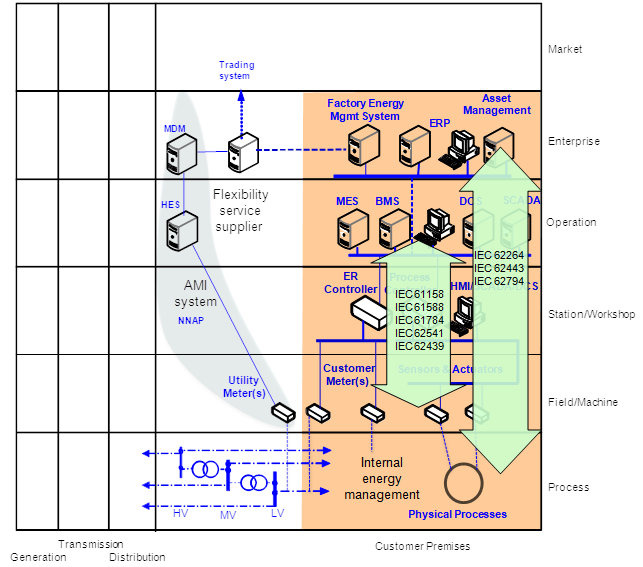
System Security for industrial systems is defined by the IEC 62443 series with some parts being updated in co-operation with ISO/IEC JTC 1/SC 27.
This set of standards can be positioned as shown in the Figure above on the communication layer of SGAM.
Mapping of standards
on the information layer
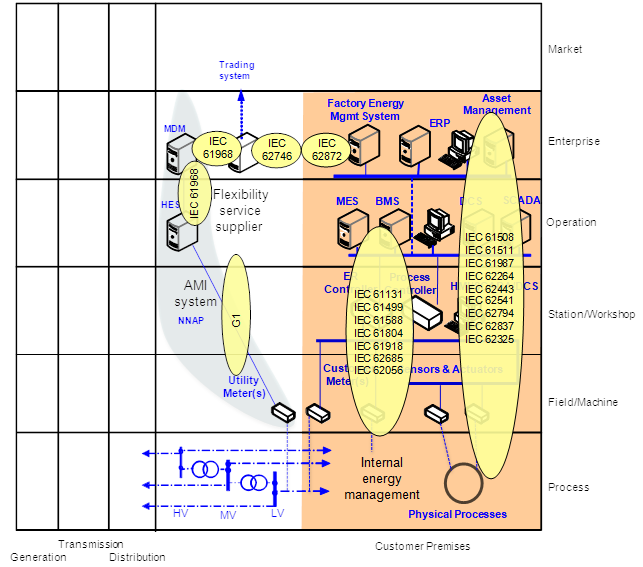
The information layer for industrial automation system is depicted above.
IEC 62872 covers the interface between industrial facilities and the smart grid.