
Description
An HBES/BACS system is a system consisting of control devices, processing equipment, network interfaces, and gateways, where the functions are distributed and linked through a common communication process, managing multiple applications in home and building premises (IEC 63044-1).
Examples of applications are heating, alarming, shading and lighting. The term “managing” includes one or more activities such as measuring, monitoring and controlling. Other terms that are used in the market to refer to HBES/BACS include the following: “home control network”, “home control system”, “smart home”, “building system” and “building automation system”.
A common communication process is a process using a common data model (such as KNX, LON, Bacnet, Dotdot, etc.), independent of the physical layer.
The term “building automation and control” (BAC) refers to the equipment, software and services for automatic control, monitoring, optimization, operation and management used for energy-efficient, economical, and reliable operation of building services. The term was ultimately defined in ISO 16484-2.
According to ISO 16484-2, “building automation and control” refers to the instrumentation, control and management technology for all building structures, plant, outdoor facilities and other equipment capable of automation. In addition to automation, operation and management with software and services (BAC functions), this also includes the required field devices, control panels, cables and wiring and the associated networks for the transfer of information. Room automation is also covered by the term. These categories of equipment can be linked to the building automation and control system via special interfaces (ISO 16484-2).
One of the functions of HBES/BACS is to manage Energy. They can then be called Energy Management Systems.
Within the Smart Grid, buildings become an active element within the power grid rather than a pure unpredictable consumer of electrical energy. Since the energy managements system controls and monitors all energy consuming devices in a building, it also controls and monitors local electrical resources such as local generation plants, as well as storages such as heating or cooling reservoirs. Therefore, local generation (such as Solar photovoltaic (PV) power supply systems) or storages (e-cars) will become more important in the future and will also be managed by an energy manager system. The energy manager (CEM / BEM) will then communicate with external systems such as the DSO management system (refer to IEC TR 63097:2017 section 4.9.13), the AMI system (refer to IEC TR 63097:2017 section 4.9.9), the ADMS (refer to IEC TR 63097:2017 section 4.9.5) and potentially other remote services systems (not described here).
Because local generation are possibly connected to such energy management systems, standards related to this domain (refer to IEC TR 63097:2017 section 4.9.8) may also be of interest.
Some of the tasks of the energy managing system are to guarantee the quality of services of the systems in the building/site, to optimise the economy of the building/asset owner and to support the grid (respect the energy flow boundaries given by the DSO) while avoiding that parts of the local energy distribution system in the premises will be overloaded.
In contradiction to the market aspect, where kWh are the guiding values, the physical aspects (securing the infrastructure) using the kW as the guiding values.
The other tasks of the energy management system is, to optimize overall energy costs by using energy optimization functions (to reduce the consumption of kWh) and by considering the best energy tariff and contractual power limitations by using load management function (to reduce the cost per kWh).
Relating to Smart Grid, the energy management system will get smarter tariff information as important input parameters for the load management function. On the other hand, energy management systems must also handle the electrical resources as well as electrical and thermal storages as integrated components of the load management to optimize the cost per kWh from the grid and to align the power consumption as much as possible with the available power
DSO as well as energy service provider e.g. Aggregator, utility, E-mobility service provider may require energy consumption and production forecast information from energy management system as well as flexibility possibilities at the PCC
Typical information flows from external to energy management systems:
· actual consumption value;
· consumption values of different elapsed periods;
· tariff
information for consumption and energy feed-in;
· actual maximum power value (Peak Demand Limiting);
· charging period information (Peak Demand Limiting);
· forecast
value;
· etc. (list not complete).
Typical information flows from CEM to external:
· possible energy flexibility;
· forecast
value;
· etc. (list not complete).
Available standards
The standards listed below are available on IEC webstore.
|
Layer |
Standard |
Comments |
|
Information, Communication |
IEC 62325 series |
Framework for energy market communications |
|
Information, Communication |
IEC 61968 series |
Application integration at electric utilities – System interfaces for distribution management |
|
Information, Communication |
IEC 60870 series |
Telecontrol equipment and systems |
|
Information Communication |
IEC PAS 62746-10-1 |
Systems interface between customer energy management system and the power management system – Part 10-1: Open Automated Demand Response (OpenADR 2.0b Profile Specification) |
|
Communication, Information |
IEC TR 62746-2 |
Systems interface between customer energy management system and the power management system – Part 2: Use cases and requirements |
|
Communication, Information |
IEC TS 62746-3 |
Systems interface between customer energy management system and the power management system – Part 3: Architecture |
|
Information, Communication |
IEC TR 62939-1 |
Smart grid user interface |
|
Information, Communication |
(refer to 4.9.13.5) |
refer to the DR management systems depicted in 4.9.13 |
|
Information, Communication |
(refer to 4.9.8.6) |
refer to the DER system depicted in 4.9.8 |
|
Information, Communication |
(refer to 4.9.10.5) |
refer to the AMI system depicted in 4.9.9 |
|
Information, Communication |
IEC 62351 series |
Power systems management and associated information exchange – Data and communications security Cyber-security aspects (see 4.10.4) |
|
Information, Communication |
ISO 16484 series |
Building automation and control systems (BACS) |
|
Information, Communication |
ISO/IEC 14543 |
Residential communication architecture, protocols, network configuration and network management that could carry smart grid signals |
|
Information, Communication |
ISO/IEC 14543-3 series |
Information technology – Home Electronic System (HES) architecture |
|
Information, Communication |
ISO/IEC 14908 series |
(LON) Control network protocol stack |
|
Information, Communication |
ISO/IEC 15067-3 |
Smart grid application specifications for demand response, distributed energy resources and local storage |
|
Information, Communication |
ISO/IEC 15045 |
Gateway to link a home network and an external network including smart grid communications |
|
Information, Communication |
ISO/IEC 18012 |
Product interoperability to provide seamless operation of home system products including energy management complying with a diversity of communication protocols |
|
Information |
IEC 62394 |
(ECHONET) direct control of household appliances within home, including remote control through the home gateway appliances (ECHONET) device object Interface for equipment maintenance |
|
Communication |
ISO/IEC 24767 |
(ECHONET) ISO/IEC 24767-1, ISO/IEC 24767-2: Secure communication layer, Secure communication for home appliances |
|
Information, Communication |
IEC 63480 IEC 62480 |
(ECHONET) Middleware adapter interface |
|
Communication |
ISO/IEC 14543-4 |
(ECHONET) ISO/IEC 14543-4-1: communication middleware – upper section |
|
Communication |
IEC 62457 |
(ECHONET) Application of TCP/IP to home network – cooperation with AV/PC equipment |
|
Component |
IEC 60364 series |
Low-voltage electrical installations |
|
Component |
IEC TS 62898 series |
Microgrids |
|
Architecture, Interfaces, Information, Communication |
IEC 63402 series |
Smart grid - Application specification - Interface and framework for customer |
|
Communication |
IEC61850-7-420 |
Communication networks and systems for power utility automation – Part 7-420: Basic communication structure – Distributed energy resources and distribution automation logical nodes |
|
|
IEC 62746 |
Systems interface between customer energy management system and the power management system.
|
|
Information, Communication |
ISO 16484 series |
BACnet – A Data Communication Protocol for Building Automation and Control Networks |
|
Information, Communication |
ISO 17800 |
Facility Smart Grid information Model. An information model to represent the Smart grid related energy information within the facility, and specifically the information that may need to be communicated to/from electric grid service providers across the SGUI. |
|
Other Specifications |
||
|
Information, Communication |
EN 13321 series |
Open data communication in building automation, controls and building management – Home and building electronic systems |
|
Information, Communication |
EN 50090 series |
Home and building electronic systems (HBES) |
|
Architecture, Interfaces, Information, Communication |
EN 50491 series |
General requirements for Home and Building Electronic Systems (HBES) and Building Automation and Control Systems (BACS) |
|
Information, Communication |
(China): GB/Z 20965 |
Information technology -- Home Electronic System (HES) architecture |
|
Information, Communication |
NAESB Energy Services Provider Interface (ESPI) standard and “Green Button” application. |
The Green Button defines energy usage information for electricity meters as well as gas and water. |
|
Information, Communication |
ANSI/CEA-2045: Modular Communication Interface |
Details mechanical, electrical, and logical characteristics of a residential appliance socket interface that allows communication devices to be separated from end devices. |
|
Information, Communication |
IEEE 1547 |
Standard for Interconnecting Distributed Resources with Electric Power Systems. Distributed generation and Micro-grid |
|
Information, Communication |
AS/NZS 4755 |
Framework for demand response capabilities and supporting technologies for electrical products Demand Response Standard for appliances, under consideration in IEC TC 59 |
|
Information, Communication |
Zigbee Home Automation |
Standard for interoperable products enabling smart homes that can control appliances, lighting, environment, energy management and security |
|
Component |
IEC 63044 series |
Home and Building Electronic Systems (HBES) and Building Automation and Control Systems (BACS) |
Coming standards
|
Layer |
Standard |
Title and comments |
|
Information, Communication |
IEC 62325 series |
Framework for energy market communications |
|
Information, Communication |
(refer to IEC TR 63097:2017 section 4.9.13.5) |
refer to the DR management systems depicted in IEC TR 63097:2017 section 4.9.13 |
|
Information, Communication |
(refer to IEC TR 63097:2017 section 4.9.8.6) |
refer to the DER system depicted in IEC TR 63097:2017 section 4.9.8 |
|
Information, Communication |
(refer to IEC TR 63097:2017 section 4.9.10.5) |
refer to the AMI system depicted in IEC TR 63097:2017 section 4.9.9 |
|
Communication |
IEC 62351 series |
Power systems management and associated information exchange – Data and communications security Cyber-security aspects (see 4.10.4) |
|
Information |
ISO 17800 |
Derived from AHSRAE SPC 201 mentioned above |
Mapping of standards
on the component layer

The Smart Home and Building automation component architecture (shown in Figure above, within a “private asset”) may be interfaced according to the following schema.
Mapping of standards
on the communication layer

Please refer to IEC TR 63097:2017 section 4.10.4 for getting details on cyber-security standards and more specifically on where and how to apply the IEC 62351 series and/or other cyber-security mechanisms.
This set of standards can be positioned as shown in Figure above on the communication layer of SGAM.
Mapping of standards
on the information layer
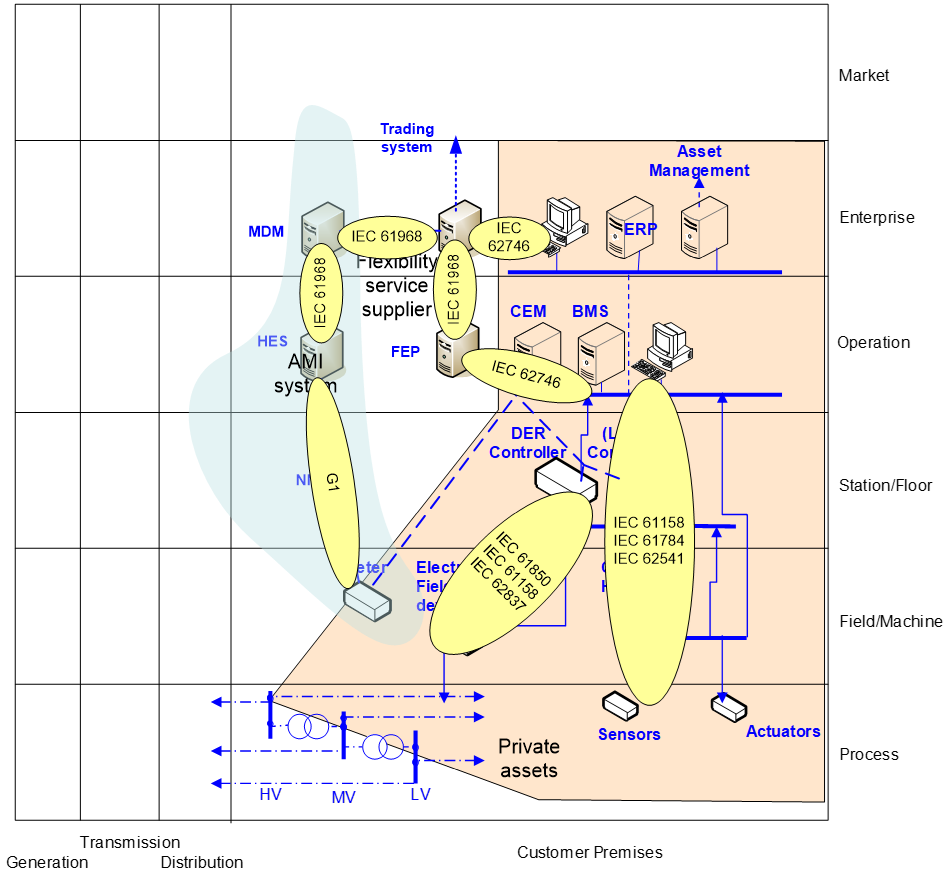
This set of standards can be positioned as shown in Figure above on the information layer of SGAM.