
Description
In considering the energy crisis and sustainable development, renewable energy generation is becoming more and more important, beside conventional bulk generation. Compared to conventional generation (thermal power, hydroelectric power, nuclear generation, etc.), renewable energy generation (wind power, solar power, etc.) is much more uncertain. It is a great challenge to interconnect renewable energy generation to power systems. Therefore, one important task of Smart Grid is to provide a dynamic platform for free and safe interconnection of renewable energy generation to power systems, including the impact of these large renewable energy generation plants on the monitoring and control of the conventional one. Smart Grid will play an important role in ensuring power supply security and sustainable development.
According to different kinds of energy, generation can be classified into the following categories:
· wind power (testing and certification of wind turbines,
design requirements of wind turbines, assessment and measurement of wind power, etc.);
· solar power (test and certification of photovoltaic devices, utility
interface of photovoltaic systems, over-voltage protection of photovoltaic systems, assessment and measurement of solar power);
· marine power (design requirements
for marine energy systems, assessment of performance of wave energy converters, etc.);
· fuel cell (safety of fuel cell power systems, performance test method
for fuel, etc.);
· Battery Energy Storage Systems, or BESS (battery safety, battery management, etc.);
· Hydroelectric
power, including pumped storage (acceptance tests of hydraulic turbines, storage pumps and pump-turbines, etc.);
· distributed generation (distributed resources
interconnected with power systems, design, test interconnecting and protection of small renewable energy and hybrid systems for rural electrification, etc.);
· nuclear
generation (interconnecting of nuclear generation, etc.);
· conventional generation (test and certification for hydraulic turbines, communication networks
for power utility automation, interconnecting of conventional power plants to power systems, active power and frequency control, ancillary services, reliability standards, protection and control, etc.)
Nowadays large-scale solar photovoltaic generation plants the size of 10 GW are under construction, and also large-scale wind power fields. These plants in such a large size will bring great challenges to power system security. Interconnecting standards for large-scale renewable energy generation plants are urgently needed.
Marine power generation will typically have different load profiles that are highly variable as far as resources are concerned. For tidal power, these load profiles are predictable; however, for wave power, the nature of the resource results in an intermittent loading profiling, similar to some extent to wind energy. Where a Smart Grid is to be designed to incorporate a wave or tidal generation unit, the designer shall take into account the intermittency and possible profiles of this generation. The designer shall consider the requirements and information provided in the IEC 62600 series. Designers of Smart Grids that are to incorporate a wave or tidal generation unit shall consider the work programme of TC 114 in order to identify any forthcoming documents that could be relevant
A growing share of renewable energy sources connected to the power grid is foreseen and will lead to a steady transition towards a complex combination of a few large centralized power plants and a great number of small and decentralized power generating facilities. Integrating these facilities into a reliable and affordable power system will require an unprecedented level of co-operative action within the electric industry and between the industry and states.
Flexibility is a more and more important issue for power system. The Generation management system will address such challenges as:
· expand sub-hourly dispatch
and intra-hour scheduling;
· improve reserves management;
· improve ancillary services
management;
· access greater flexibility in the dispatch of existing generating plants;
· focus
on flexibility for new generating plants;
· focus on Virtual Power Plant (VPP) and hybrid power plant.
Available standards
The standards listed below are available on IEC webstore.
|
Layer |
Standard |
Title and comments |
|
Information |
IEC 61131 series |
Programmable controllers |
|
Information |
IEC 61499 series |
Function blocks |
|
Information |
IEC 61804 series |
Function blocks (FB) for process control |
|
Information |
IEC 62264 series |
Enterprise-control system integration (ISA 95) |
|
Information |
IEC 61512 series |
Batch control (ISA 88) |
|
Information |
IEC 61987 series |
Industrial-process measurement and control – Data structures and elements in process equipment catalogues |
|
Information |
IEC 61360 |
CDD – Common Data Dictionary, available from <http://std.iec.ch/iec61360http://std.iec.ch/iec61360> |
|
Information |
IEC 61968-1 IEC 61968-2 IEC 61968-3 IEC 61968-4 IEC 61968-5 IEC 61968-6 IEC 61968-8 IEC 61968-9 IEC 61968-11 |
Application integration at electric utilities – System interfaces for distribution management |
|
Information |
IEC 61968-6 |
Application integration at electric utilities – System interfaces for distribution management – Part 6: Interfaces for maintenance and construction |
|
Information |
IEC 61970-1 IEC 61970-2 IEC 61970-301 IEC 61970-302IEC 61970-401 IEC 61970-452 IEC 61970-453 IEC 61970-456 IEC 61970-457 IEC 61970-501 IEC 61970-552 IEC 61970-600-1 IEC 61970-600-2 |
Energy management system application program interface (EMS-API) |
|
Information |
IEC 62325-301 IEC 62325-351 IEC 62325-451-1 IEC 62325-451-2 IEC 62325-451-3 IEC 62325-451-4 IEC 62325-451-5 IEC 62325-451-6 IEC 62325-451-7 IEC 62325-451-8 IEC 62325-451-10 |
Framework for energy market communications CIM information model (Market profiles) |
|
Information |
IEC 62361-100 IEC 62361-102 IEC 62361-103 |
Interoperability in the long term – Part 100 – CIM Profiles to XML mapping Part 102: CIM - IEC 61850 harmonization Part 103: Standard Profiling |
|
Information |
IEC 61850-7-4 IEC 61850-6 |
Communication networks and systems for power utility automation Core Information model for the IEC 61850 series |
|
Information |
IEC 61850-7-410 |
Communication networks and systems for power utility automation – Part 7-410: Basic communication structure – Hydroelectric power plants – Communication for monitoring and control |
|
Information |
IEC 61400-25-2 |
Wind turbines – Part 25-2: Communications for monitoring and control of wind power plants – Information models |
|
Information |
IEC 62541-1 IEC 62541-2 IEC 62541-3 IEC 62541-5 IEC 62541-8 IEC 62541-9 IEC 62541-10 IEC 62541-11 IEC 62541-12 IEC 62541-13 IEC 62541-14 IEC 62541-16 IEC 62541-17 IEC 62541-18 IEC 62541-19 IEC 62541-20 IEC 62541-21 IEC 62541-22 IEC 62541-23 IEC 62541-24 IEC 62541-100 |
OPC unified architecture OPC foundation open specifications for OPC UA parts 11 and PLCopen are not yet announced in the IEC SC 65E work program |
|
Information |
IEC 62325-450 |
Framework for energy market communications –Part 450: Profile and context modelling rules CIM information model (Market profiles) |
|
Communication |
IEC TR 61850-90-4 |
Communication networks and systems for power utility automation – Part 90-4: Network engineering guidelines Guidelines for communication within substation |
|
Communication |
IEC 61158 series IEC 61784-1 |
Industrial communication networks – Fieldbus specifications Industrial communication networks – Profiles – Part 1: Fieldbus profiles |
|
Communication |
IEC 62439 series |
Industrial communication networks – High availability automation networks Based on the ISO/IEC 8802-3 (Ethernet) technology |
|
Communication |
IEC 62541-4 IEC 62541-6 IEC 62541-7 |
OPC unified architecture IEC standards for OPC UA |
|
Communication |
IEC 61850-8-1 |
Communication networks and systems for power utility automation – Part 8-1: Specific communication service mapping (SCSM) – Mappings to MMS (ISO 9506-1 and ISO 9506-2) and to ISO/IEC 8802-3 IEC 61850 communication except Sample values |
|
Communication |
IEC TR 61850-90-1 |
Communication networks and systems for power utility automation – Part 90-1: Use of IEC 61850 for the communication between substations |
|
Communication, Information |
IEC TR 61850-90-2 |
Communication networks and systems for power utility automation |
|
Communication |
IEC 60870-5-104 |
Telecontrol equipment and systems – Part 5-104: Transmission protocols – Network access for IEC 60870-5-101 using standard transport profiles to connect to the Plant (standard transport protocol) |
|
Communication |
IEC 60870-5-101 |
Telecontrol equipment and systems – Part 5-101: Transmission protocols – Companion standard for basic telecontrol tasks to connect to the Plant (serial link) |
|
Communication |
IEC 60870-5-103 |
Telecontrol equipment and systems – Part 5-103: Transmission protocols – Companion standard for the informative interface of protection equipment to connect to protection Relays |
|
Communication |
IEC 61850-9-2 |
Communication networks and systems for power utility automation – Part 9-2: Specific communication service mapping (SCSM) – Sampled values over ISO/IEC 8802-3 IEC 61850 Sample values communication |
|
Communication |
IEC/PAS 61850-9-3 |
Communication networks and systems for power utility automation – Part 9-3: Precision time protocol profile for power utility automation |
|
Communication |
IEC 61968-100 |
Application integration at electric utilities – System interfaces for distribution management – Part 100: Implementation profiles |
|
Communication |
IEC 62351 series |
Power systems management and associated information exchange – Data and communications security Cyber-security aspects (see 4.10.4) |
|
Communication |
IEC 62357 series |
Power systems management and associated information exchange |
|
Communication |
IEC 62443 series |
Industrial communication networks – Network and system security |
|
Component |
IEC 60255 series |
Measuring relays and protection equipment |
|
Component |
IEC 61400 series |
Wind turbines |
|
Component |
IEC 60904 series |
Photovoltaic devices |
|
Component |
IEC 61727 |
Photovoltaic (PV) systems – Characteristics of the utility interface |
|
Component |
IEC 62446 |
Photovoltaic (PV) systems - Requirements for testing, documentation and maintenance |
|
Component |
IEC 62282 series |
Fuel cell technologies |
|
Component |
IEC 60193 |
Hydraulic turbines, storage pumps and pump-turbines – Model acceptance tests |
|
Component |
IEC 62270/IEEE 1249 |
Guide for computer-based control for hydroelectric power plant automation |
|
Component |
IEC 63198/IEEE 2775 |
Technical guidelines for smart hydroelectric power plant |
|
Component |
IEEE Std 1547 |
Standard for Interconnecting Distributed Resources with Electric Power Systems |
|
Communication |
IEC TS 62872-1 |
Industrial-process measurement, control and automation - Part 1: System interface between industrial facilities and the smart grid |
|
Communication |
IEC 62872-2 |
Internet of Things (IoT) – Application framework for industrial facility demand response energy management |
|
Communication |
IEC 63376 |
INDUSTRIAL FACILITY ENERGY MANAGEMENT SYSTEM (FEMS) – Functions and Information Flows |
|
Component |
ISO 20140-5 |
Automation systems and integration - Evaluating energy efficiency and other factors of manufacturing systems that influence the environment - Part 5: Environmental performance evaluation data |
|
Component |
IEC TR 62837 |
Energy efficiency through automation systems |
Coming standards
|
Layer |
Standard |
Title and comments |
|
Information |
IEC 61970-458 IEC 61970-502-8 |
Energy management system application program interface (EMS-API) |
|
Communication |
IEC 61850-8-2 |
Communication networks and systems for power utility automation – Part 8-2: Specific communication service mapping (SCSM) – Mappings to Extensible Messaging Presence Protocol (XMPP) |
|
Communication |
IEC/IEEE 61850-9-3 |
Communication networks and systems for power utility automation – Part 9-3: Precision time protocol profile for power utility automation |
|
Communication |
IEC 62351 series |
Power systems management and associated information exchange – Data and communications security Cyber-security aspects (refer to 4.10.4) |
|
Component |
IEC TC4 WG40 |
Technical Specifications for Digitalization of Operation and Maintenance in Hydropower Assets |
|
Communication |
IEC 62541-16 |
OPC Unified Architecture - Part 15: Safety |
|
Communication |
IEC 62443 series |
Industrial communication networks – Network and system security |
Mapping of standards
on the component layer

As shown in the Figure above, the Generation operation component architecture involves all Zones from Process to Enterprise levels, which may be interconnected through wires or communication.
The lower level components are easily identified as Generation related or not. The higher level components are more tightly integrated with Market, Asset Management and Transmission related components.
The Process level is populated with:
· electrical equipment, sensors and actuators (such as current and voltage transformers, breakers or switches);
· electro-mechanical
machines with associated sensors and actuators (turbines and generators);
· industrial equipment with general purpose sensors and actuators (typically hydro
or thermal plant).
The Field level is in charge of protection, monitoring and control. It is mostly based on PLCs, which can be replaced by IEDs for electrical equipment.
Above the DCS HMI, higher level components are to be integrated with Market, Asset Management and Transmission related components.
The Transmission EMS/SCADA system communicates with the Generation Management System RTU to implement the Secondary Generation Control.
Mapping of standards
on the communication layer
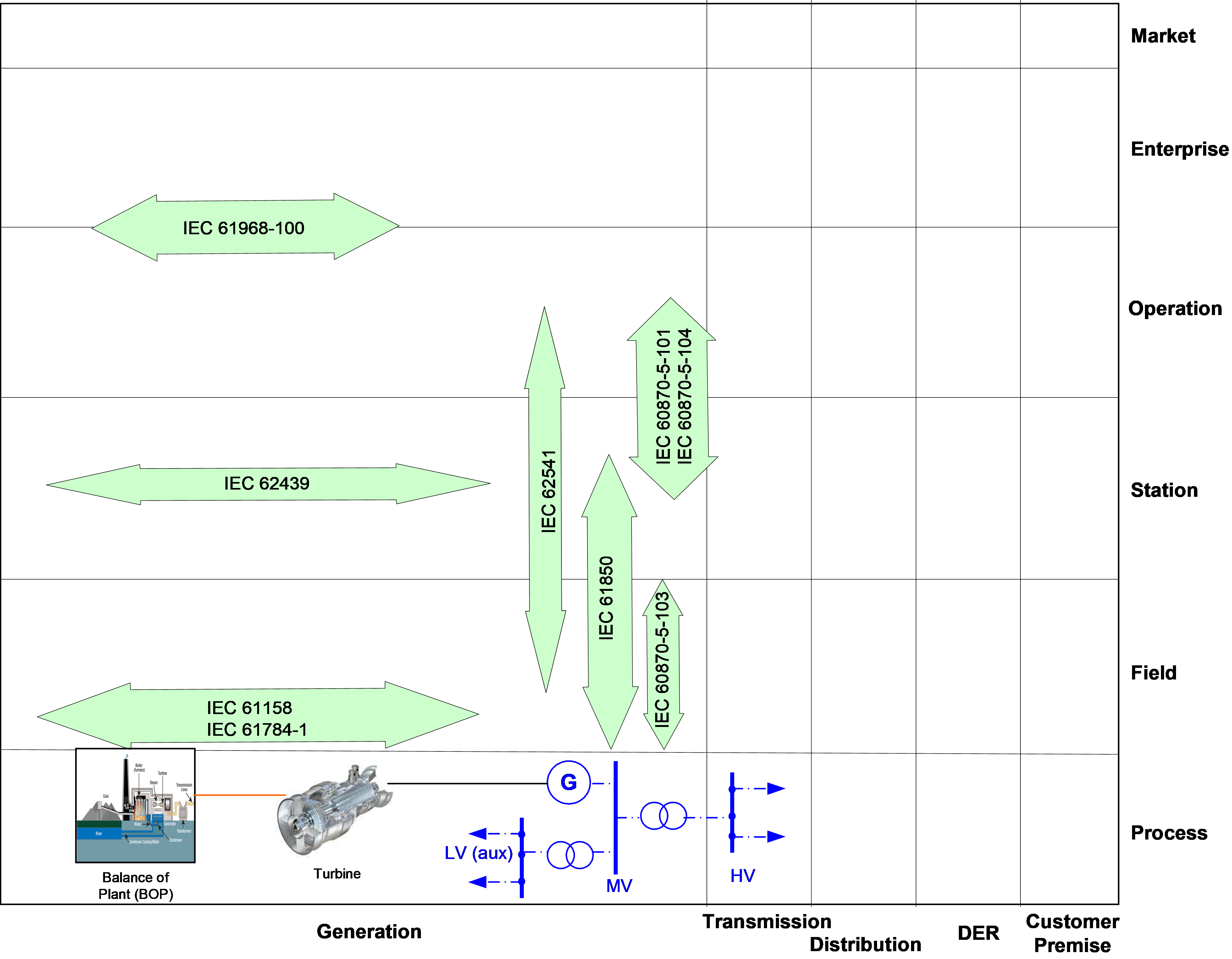
Within the Generation management system, the significant communication protocols, as shown in the Figure above, are the following:
· Field bus protocols are
standardized within IEC 61158 series and IEC 61784-1.
· Mission-critical networks hosted in Station level rely on IEC 62439 series high availability
automation networks.
· The communication standards of the IEC 60870-5 family (profiles 101 and 104 to connect to the Plant, profile 103 to connect to protection Relays).
· The messaging standard IEC 61968-100 for Enterprise and Operation level messages.
· The communication standards
of the IEC 61850 family for IED components.
· The communication standards of the IEC 62541 family for OPC UA servers and clients.
This set of standards can be positioned in this way on the communication layer of SGAM.
Mapping of standards
on the information layer

The information layer of Generation management, presented in the Figure above, is based on the following families of information models:
· Field device functions
and interfaces are standardized within IEC 61131 series, with associated work in progress: IEC 61499 and IEC 61804 series.
· Plant electrical
devices are standardized within the IEC 61850 series, with work in progress for other field devices: IEC 61400-25-2 for wind turbines, IEC 61850-7-410 for hydro power plants.
· Industrial
plant information models are standardized in the following family: IEC 62264 series (ISA 95), IEC 61512 (ISA 88), IEC 61987 series and IEC 61360. Their relevance to the Generation management system is at the Station
level.
Operation and Enterprise level information models are standardized in the CIM family: IEC 61968, IEC 61970, IEC 62325 series and IEC 62361. The relevance of IEC 61968 parts to Generation has not been formally assessed yet. Few parts are fully appropriate for Generation domain, but most parts can be extended to become relevant to Generation domain.
Mappings between most of these information models and the IEC 62541 address space are defined or in progress.