
Description
Demand Response or Load Management is a feature which is closely connected to DER (4.9.8), AMI systems (4.9.9), HBES/BACS (4.9.14) as well as Industrial Automation systems (4.9.15). Many of the standards and descriptions have already been addressed there.
To comply with the ambitious? goals of climate policies, in the future renewable energy resources will have a larger significance. Compared to the easy planning and adjustable power generation with fossil and nuclear fuel, renewable power generation can only partially be planned- and adjusted (e.g. solar, wind) or is subject to other restrictions (hydro). This means that in the future the share of “easily” adjustable power generation will decrease, which poses new challenges to a future energy management system.
A further aim of climate policies is to move many energy demands to electricity, especially, transport, in the form of electric vehicles, and heating, in the form of heat pumps. These new loads will increase the demand for electricity which requires greater generation capacity and also greater capacity of the power network. The need to maximise network capacity and minimise the cost of network reinforcement adds a further challenge to the future energy management system. Some consumers are also adding storage to their home energy systems to maximise their use of their local renewable generation or move closer to grid independence. Suitably equipped EVs can also provide an electricity storage capability and be used for V2G or V2X services.
Homes in future can also be expected to include electricity sources, PV or battery storage (possibly in an EV) as well as the new electricity loads. This creates the possibility of managing the energy demands in the home to maximise the value of their local generation capacity. Standards for home energy management are being developed to manage this as well as the need to ensure that the HEM operates in ways that are compatible to power network operators requirements.
One approach to the solution of this challenge is the paradigm shift from “generation follows load” to “load adapts to generation” and from increased demand is met with network reinforcement to constraining demand to available capacity. Therefore load management will have a much higher significance in future. Load management has been performed in the past, e.g. large and small consumers (e.g. night storage heater). However it was limited to the prevention of peak loads and the respective load shedding of day and night load curves. These solutions, however, had only a limited influence on the control of individual loads.
Demand response (DR) is similar to dynamic demand mechanisms to manage customer consumption of electricity in response to supply conditions, for example, having electricity customers reduce their consumption at critical times or in response to market prices. The difference is that demand response mechanisms respond to explicit requests or price signals to reduce or shut off demand whereas dynamic demand devices passively shut off when stress in the grid is sensed. Demand response is generally used to refer to mechanisms used to encourage consumers to reduce demand, thereby reducing the peak demand for electricity.
Load management / Demand Response can be classified in two respects:
• Energy management: this means the energy balance needs to be achieved in each demand period, generally 15 minutes to 60 minutes.
• Near real-time power management: this means energy needs to be balanced at all times.
The latter imposes significantly higher requirements on the control speed and can be realized only through fully automated, closed control loops. In all cases an integration of the consumer in the power grid automation requires a seamless communication. Area-wide smart meter utilization will be a major contributor to such a development. Load management and demand response solutions can be realized through an interface to control individual loads within the consumer premises.
An incentive can be set by a price signal, which is transmitted to the consumer, for example, a real time price signal. The consumer then still has the choice of whether they will change their own power consumption according to the set price incentives. In this case it is not important whether such a decision is taken by the consumer themselves or an intelligent control system. The behaviour of such systems is not easily predictable, no matter which of the above systems is in place. Therefore, these systems cannot support a real fast energy balancing and are therefore only capable of supporting energy management. Another problem with incentives is the choice of the optimal incentive. Normally incentive programs will follow monetary considerations. However, since electrical energy is a basic necessity this will pose a conflict between social fairness and a sufficiently high price difference between times of high and low power availability.
Therefore, incentives will not be sufficient in the long run and will have to be extended with the addition of direct intervening control mechanism. An integration of power grid automation and building and home automation offers the possibility to make full use of the flexibility and energy storage option of consumers for power grid balancing.
This power grid balancing requires load models for the optimizing software, in order to be able to predict the load behaviour of the overall system. These load profiles describe the limits of time flexibility of consumers and their energy storage potential. Only with this information available can a predictive load management be realized, which avoids a decreasing quality of energy supply for the consumer.
This approach relies upon the aggregation of individual capabilities of grid users and raises the question of considering a generic interface for any type of user. It must also be recognised that components of the energy system have their own specific expectations. An EV OEM will expect to be able to manage their customers’ vehicles to meet their own priorities; having sufficient charge for journeys or maximising battery life whilst heating and cooling appliances should not allow ambient temperatures to become uncomfortable. This adds a further challenge for demand response, it must respect the expectations of all stakeholders.
Available standards
The standards listed below are available on IEC webstore.
|
Layer |
Standard |
Title and comments |
|
|
Information, Communication |
IEC 62325 series |
Framework for energy market communications |
|
|
Information, Communication |
IEC 61968 series |
Application integration at electric utilities – System interfaces for distribution management |
|
|
Communication, Information |
IEC PAS 62746-10-1 |
IEC PAS based on OpenADRa |
|
|
Communication, Information |
IEC TR 62746-2 |
Systems interface between customer energy management system and the power management system – Part 2: Use cases and requirements |
|
|
Communication, Information |
IEC TS 62746-3 |
Systems interface between customer energy management system and the power management system – Part 3: Architecture |
|
|
Communication, Information |
IEC 63402-1 ED1 |
Energy Efficiency - Customer Energy Management Systems -- Part 1: General Requirements and Architecture |
|
|
Information |
IEC SRD 63417: |
Guidance and plan to develop smart energy ontologies |
|
|
Information, Communication |
(refer to 4.9.8.6) |
refer to the DER system depicted in |
|
|
Information, Communication |
IEC 63380 family |
Standard interface for connecting charging stations to local energy management systems |
|
|
Information |
IEC 63382 family |
Management of Distributed Energy Storage Systems based on Electrically Chargeable Vehicles (ECV-DESS) |
|
|
Information |
IEC 62872 family |
Industrial-process measurement, control and automation |
|
|
Information, Communication |
(refer to |
refer to the AMI system depicted in 4.9.9 |
|
|
Information, Communication |
(refer to ) |
refer to the HBES/HBAC system depicted in 4.9.14 |
|
|
Information, Communication |
(refer to |
refer to the Industrial system depicted in 4.9.15 |
|
|
Information, Communication |
IEC 62351 series |
Power systems management and associated information exchange – Data and communications security Cyber-security aspects (see 4.10.4) |
|
|
Information, Communication |
ISO 16484 series |
Building automation and control systems (BACS) |
|
|
Information, Communication |
ISO/IEC 14543-3 series |
Information technology – Home electronic system (HES) architecture |
|
|
Information, Communication |
ISO/IEC 15045-1 |
IT – Home Electronic System (HES) Gateway – Part 1: A residential gateway model for HES |
|
|
Information, Communication |
ISO/IEC 15045-2 |
IT – Home Electronic System (HES) Gateway – Part 2: Modularity and protocol |
|
|
Information |
ISO/IEC 15067-3 |
IT – Home Electronic System - (HES) application model – Part 3: Model of an Energy Management System |
|
|
Information |
ISO/IEC 18012-1 |
Home electronic system – Guidelines for product interoperability – Part 1: Introduction |
|
|
Information |
ISO/IEC 18012-2, |
Home electronic system – Guidelines for product interoperability – Part 2: Taxonomy and application interoperability model |
|
|
Information, Communication |
IEC TR 62939-1 |
Smart grid user interface |
|
|
Information |
ISO 17800 |
Facility Smart Grid Information Model - An information model to represent the Smart grid related energy information within the facility, and specifically the information that may need to be communicated to/from electric grid service providers across the SGUI. |
|
|
Information, Communication |
ISO 16484 series |
BACnet – A Data Communication Protocol for Building Automation and Control Networks |
|
|
Regional/national Standards and Technical Specifications |
|||
|
Information, Communication |
EN 13321 series |
Open data communication in building automation, controls and building management – Home and building electronic systems |
|
|
Information, Communication |
EN 50090 series |
Home and building electronic systems (HBES) |
|
|
Information, Communication |
EN 50491 |
General requirements for Home and Building Electronic Systems (HBES) and Building Automation and Control Systems (BACS) |
|
|
Information |
(China): GB/Z 20965 |
Information technology -- Home Electronic System (HES) architecture |
|
|
Information, Communication |
OASIS Energy Interoperation 1.0 |
Demand response (DR) and distributed energy resources (DER) communications as well as price communication and market transactions. |
|
|
Information, Communication |
OpenADR 2.0 and 3.0 |
A profile on the OASIS Energy Interoperation standard and serves DR and DER communications as well as price distribution for both wholesale and retail markets. Version 3.0 provides an additional, simplified way to add OpenADR functionalities |
|
|
Information, Communication |
IEEE 2030.5 |
Smart energy Profile 2.0. Customer premises communications of pricing, demand response signals, messaging, and energy usage to inhome devices. |
|
|
Information, Communication |
NAESB Energy Services Provider Interface (ESPI) standard and “Green Button” application |
The Green Button defines energy usage information for electricity meters as well as gas and water. |
|
|
Information, Communication |
(US) ANSI/CEA-2045: |
Modular Communication Interface. Details mechanical, electrical, and logical characteristics of a residential appliance socket interface that allows communication devices to be separated from end devices. |
|
|
Information |
EN 50491-12 |
(CENELEC )Smart Grid interface and framework for Customer Energy Management |
|
|
Information, Communication |
AS/NZS 4755 |
Framework for demand response capabilities and supporting technologies for electrical products Demand Response Standard for appliances, under consideration in IEC TC 59 |
|
|
Information, Communication |
AS 5438 |
Interoperability Requirements for Inverter Energy Systems |
|
|
Information, Communication |
PAS 1878 |
Energy Smart Appliances - System Functionality and Architecture |
|
|
a IEC PAS 62746-10-1 is first proposed over simple HTTP transport layer, or over XMPP – refer to 4.10.1.4. |
|||
Coming standards
|
Layer |
Standard |
Title and comments |
|
Information, Communication |
IEC 62056-11-1 and 11-2 |
Electricity metering data exchange – Revenue Grade sub-Meters and Dedicated Metering Devices |
|
Information, Communication |
IEC 62325 series |
Framework for energy market communications |
|
Information Communication |
IEC 62746 series |
System interfaces and communication protocol profiles relevant for systems connected to the Smart Grid |
|
Information, Communication |
(refer to |
refer to the AMI system depicted in 4.9.9 |
|
Information, Communication |
(refer to |
refer to the DER system depicted in 4.9.8 |
|
Information, Communication |
(refer to |
refer to the HBES/HBAC system depicted in 4.9.14 |
|
Information, Communication |
(refer to |
refer to the Industrial system depicted in 4.9.15 |
|
Communication |
IEC 62351 series |
Power systems management and associated information exchange – Data and communications security Cyber-security aspects (see 4.10.4) |
|
Regional/national Standards and Technical Specifications |
||
|
Information |
prEN 50491-12 |
(fits CLC TR 50572 type H2/H3 needs) – Smart grid – Application specification. Interface and framework for customer energy management |
|
Information |
prEN 50763 |
Assessment of electrical flexibility services from power network perspective |
Mapping of standards
on the component layer
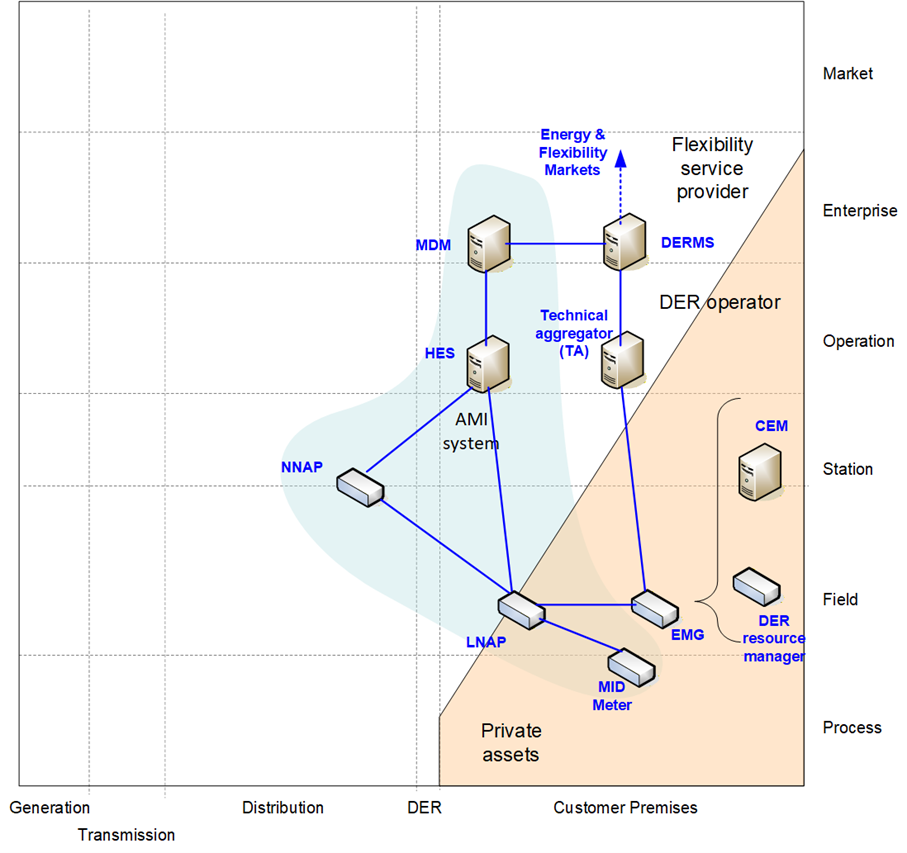
The principal functional components used for flexibility purposes, as shown in the diagram above, are the CEM and HAN, and – if utilizing the AMI – the smart meter, the LN and LNAP, NN and NNAP, the WAN, MDM and HES, as indicated below.
Mapping of standards
on the communication layer
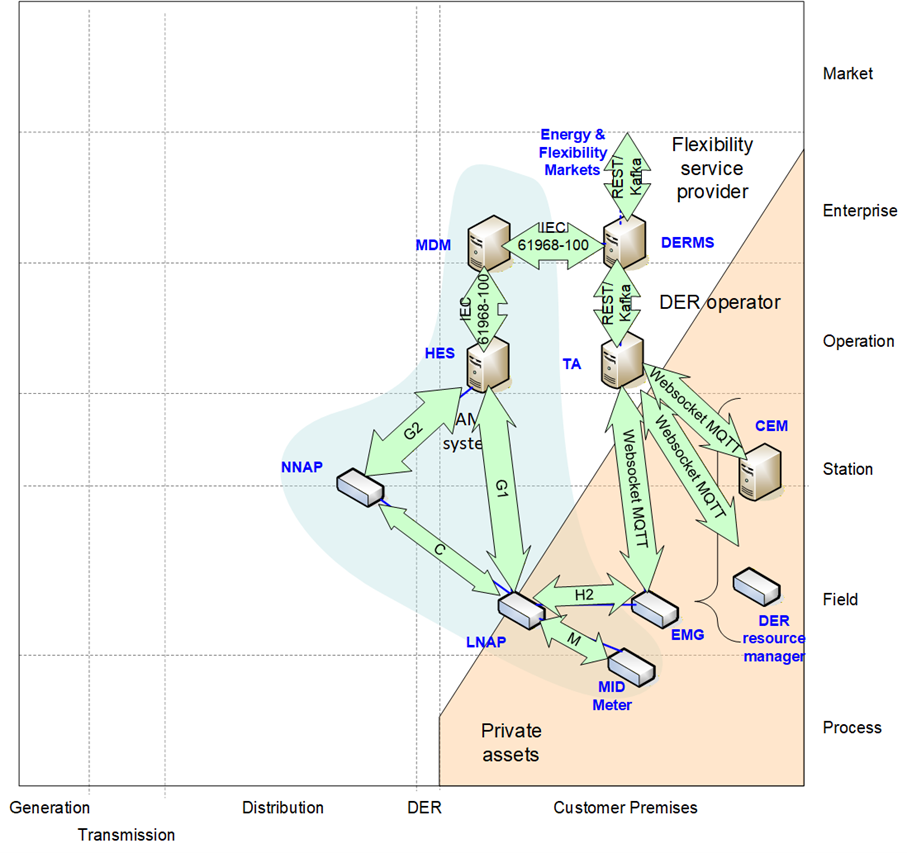
Work is underway in IEC TC 57, as well as in TC13 as soon as smart metering is used. The diagram above shows a possible mapping of communication standards for this application.
Mapping of standards
on the information layer
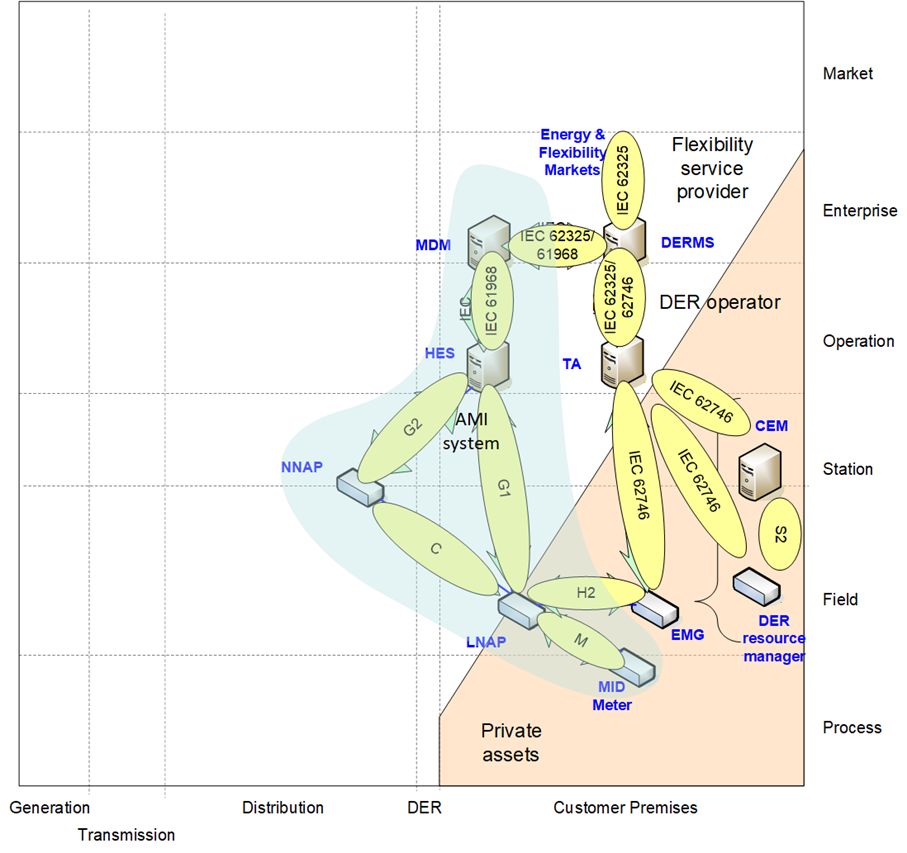
The diagram above shows how information level standards may be mapped to support the considered system (as an example).