
Description
A marketplace refers to a system where buyers and sellers of a commodity (here related to electricity) meet to purchase or sell a product in a transparent and open manner according to guidelines called market rules. We can differentiate several kinds of marketplaces depending on the product sold on the marketplace:
wholesale electricity marketplace generally operated by power exchanges (note that, there are some derived types of this concept therefore it contains broad meaning, depending on the context. For examples, there is a tight Regional Transmission Operator model often seen in the US, in which a wholesale market is directly operated by system operator in an integrated manner with reliability management, not by third-party PX. In other region like Korea, there is so-called a single buyer model, in which a regulated retail entity buys energy on behalf of individual customers and apportion volume at a regulated price, without using separated PX platforms. Hereinafter, such marketplaces are also interpreted as a derivative form of this category.);
• marketplaces for products needed for grid reliability (e.g., transmission capacity, ancillary services, balancing energy, financial transmission rights) operated by Transmission System Operators;
• forward capacity markets to secure adequacy of supply;
• retail marketplaces, for instance to sell or purchase flexibility.
Furthermore, markets can be differentiated based on geographical coverage starting from local markets (i.e. within a micro-grid area) to regional, countrywide and cross-country markets.
The marketplace systems are accessed by so-called market participants who can be electricity power producers, suppliers, industrial consumers, virtual power plants, aggregators, DER operators, load serving entities etc.
Available standards
The standards listed below are available on IEC webstore.
|
Layer |
Standard |
Title and comments |
|
Information |
IEC 61968 series IEC 61970 series IEC 62325 series |
Application integration at electric utilities – System interfaces for distribution management Energy management system application program interface (EMS-API) Framework for energy market communications Common Information model |
|
Information |
IEC 62325-301 |
Framework for energy market communications – Part 301: Common information model (CIM) extensions for markets |
|
Information |
IEC 62325-351 |
Framework for energy market communications – Part 351: CIM European market model exchange profile |
|
Information |
IEC 62325-450 |
Framework for energy market communications – Part 450: Profile and context modelling rules |
|
Information |
IEC 62325-451-1 |
Framework for energy market communications – Part 451-1: Acknowledgement business process and contextual model for CIM European market |
|
Information |
IEC 62325-451-2 |
Framework for energy market communications – Part 451-2: Scheduling business process and contextual model for CIM European market |
|
Information |
IEC 62325-451-3 |
Framework for energy market communications – Part 451-3: Transmission capacity allocation business process (explicit or implicit auction) and contextual models for European market |
|
Information |
IEC 62325-451-4 |
Framework for energy market communications – Part 451-4: Settlement and reconciliation business process, contextual and assembly models for European market |
|
Information |
IEC 62325-451-5 |
Framework for energy market communications – Part 451-5: Problem statement and status request business processes, contextual and assembly models for European market |
|
Information |
IEC 62325-451-6 |
Framework for energy market communications - Part 451-6: Publication of information on market, contextual and assembly models for European-style market |
|
Information |
IEC 62325-451-7 |
Framework for energy market communications - Part 451-7: Balancing processes, contextual and assembly models for European style market |
|
Information |
IEC 62325-451-8 |
Framework for energy market communications - Part 451-8: HVDC Scheduling process, contextual and assembly models for European style market |
|
Information |
IEC 62325-503 |
Framework for energy market communications – Part 503: Market data exchanges guidelines for the IEC 62325-351 profile |
|
Communication |
IEC 62351 series |
Power systems management and associated information exchange – Data and communications security Cyber-security aspects (see 4.10.4) |
|
Information |
IEC 62746-4 |
Systems interface between customer energy management system and the power management system - Part 4: Demand Side Resource Interface |
|
Information |
IEC 62746-10-1 |
Systems interface between customer energy management system and the power management system - Part 10-1: Open automated demand response (OpenADR) |
|
Information |
IEC TS 62056-6-9:2016: |
CIM-IEC 62056 series mapping |
|
Information |
European Harmonized Electricity Market Role Model[1] |
Joint ENTSO-E, EU DSO Entity |
|
Information |
ENTSO-E Reserve Resource Planning (ERRP) |
Implementation guide latest revision V4R1 |
|
Information |
IEC 62056-11-1 and -11-2 |
Revenue Grade sub-Meters and Dedicated Measuring Devices for supporting DER & Flex services |
[1] https://www.entsoe.eu/data/cim/role-models/
Coming standards
|
Layer |
Standard |
Title and comments |
|
Information |
OpenADR 3 |
This standard is intended to complement the OpenADR 2.0a/b Profile Specifications. It provides an additional, simplified way to add OpenADR functionalities in current, as well as different and new scenarios. |
|
Information |
62325 451-n series
|
Extensions in IEC 62325 451-n series based on Demand Response Implementations, Profiles on Prequalification, Bid and Activation on Congestion management & Voltage control services |
|
Information |
IEC 62056-1-0 |
In amendment cycle because of the revised Edge architecture opening Smart Meter Data access from the edge to Flex and DER Operators |
Mapping of standards
on the component layer
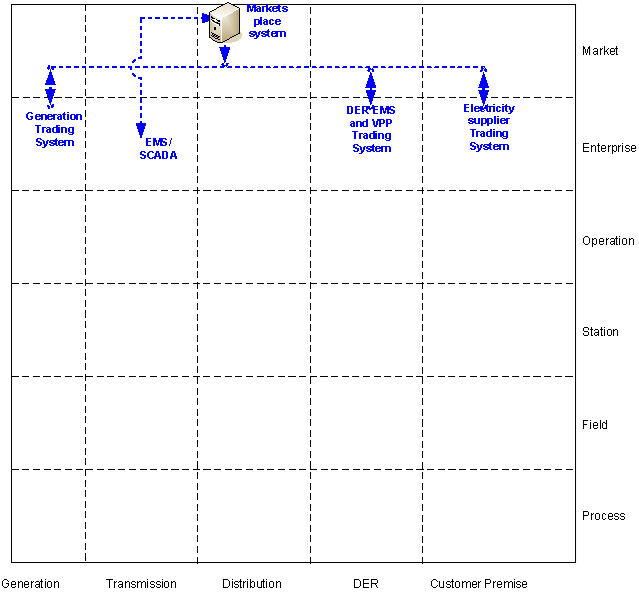
As shown in the diagram above, the following components are involved:
• Trading systems at enterprise zone. Trading systems are used at various areas such as Generation and DER.
• Operation systems at operation zone. They interact with trading systems to translate commercial/contractual positions into physical orders to be transmitted to lower zones (Process, Fields).
The diagram summarizes the way components are linked.
Mapping of standards
on the communication layer
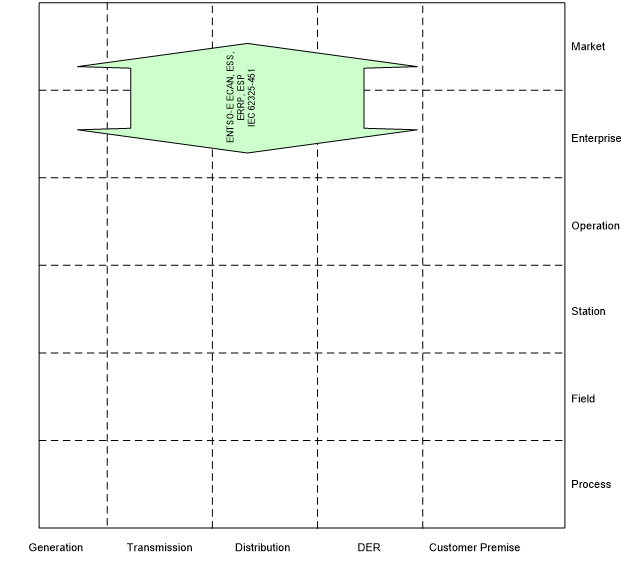
Markets involve data exchange between the central marketplace systems and market participants IT systems (trading systems).
The communication layer, as shown in the diagram above, is mostly around IEC 62325-450, IEC 62325-451-1 and IEC 62325-503.
Worldwide standards such as SOA, XML, SOAP, etc. are leveraged as much as possible according to Enterprise Service Bus pattern.
This set of standards can be positioned as shown above on the communication layer of SGAM.
Mapping of standards
on the information layer
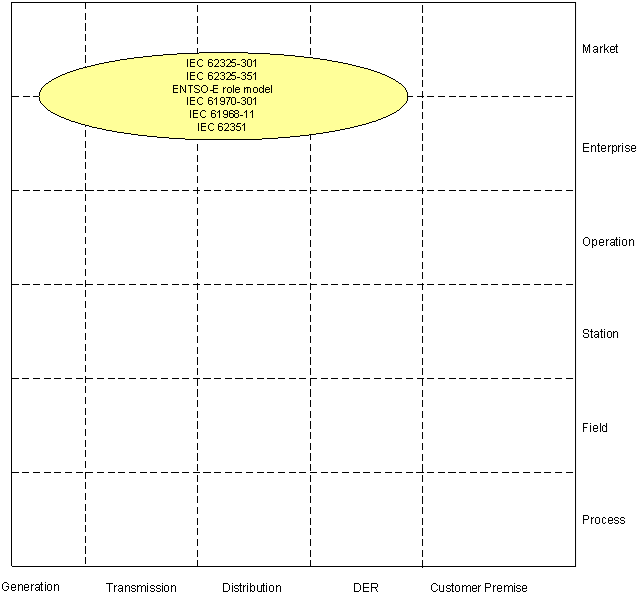
Markets involve information exchange between the central market place systems and market participants IT systems (trading systems).
The information layer, as shown in the diagram above, is mostly around IEC 62325-301 and IEC 62325-351 using the ENTSO-E Market Data Exchange Standard (MADES) as a reference.
This set of standards can be positioned as shown above on the information layer of SGAM.