
Description
The task of building Substation Automation Systems rests on the strong technological development of large-scale integrated circuits, leading to the present availability of advanced, fast, and powerful microprocessors. The result has been an evolution of substation secondary equipment, from electro-mechanical devices to digital devices. This in turn has provided the possibility of implementing Substation Automation using several intelligent electronic devices (IEDs) to perform the required functions (protection, local and remote monitoring and control, asset management, metering, etc.).
Substation Automation is quite a mature application, which has been performed for many years. Its core functions are:
· protection;
· local
control and supervision;
· remote control and supervision;
· equipment supervision;
· metering;
· measuring;
· online diagnosis.
The functionality of microprocessor-based IEDs includes multiple functions for protection, control and monitoring. This is the basis of Substation Automation systems which have been widely introduced in substations but with proprietary communication solutions. The driving force for a communication standard is interoperability between devices of different suppliers to be independent from one supplier and one generation of IEDs. IED communication is also referred to as “IEC 61850 station-bus application”, which lets IEDs communicate with each other and with a substation controller. An extension to this communication is the so called “IEC 61850 process bus”. This technology (see Figure below) allows signals of a conventional or non-conventional instrument transformer to be sampled and digitally transmitted to one or several protection and measuring devices.

Available standards
The standards listed below are available on IEC webstore.
|
Layer |
Standard |
Comments |
|
Information |
IEC 61850-7-4 IEC 61850-7-3 IEC 61850-7-2 IEC 61850-6 |
Communication networks and systems for power utility automation Core Information model and language for the IEC 61850 series |
|
Information |
IEC 61850-7-410 |
Communication networks and systems for power utility automation – Part 7-410: Basic communication structure – Hydroelectric power plants – Communication for monitoring and control |
|
Information |
IEC 61850-7-420 |
Communication networks and systems for power utility automation – Part 7-420: Basic communication structure – Distributed energy resources logical nodes |
|
Information |
IEC 61850-7-420 |
Communication networks and systems for power utility automation - Part 7-420: Basic communication structure - Distributed energy resources and distribution automation logical nodes |
|
Information |
IEC TS 61850-80-1 |
Communication networks and systems for power utility automation – Part 80-1: Guideline to exchanging information from a CDC-based data model using IEC 60870-5-101 or IEC 60870-5-104 Mapping of IEC 61850 data model over IEC 60870-5-101 and IEC 60870-5-104 |
|
Information |
IEC TS 61850-80-4 |
Communication networks and systems for power utility automation – Part 80-4: Translation from the COSEM object model (IEC 62056) to the IEC 61850 data model |
|
Information |
IEC 61400-25 series |
Wind turbines – Communications for monitoring and control of wind power plants |
|
Information |
IEC 61968 series |
Application integration at electric utilities – System interfaces for distribution management Common Information Model (System Interfaces For Distribution Management) |
|
Information |
IEC 61970 series |
Energy management system application program interface (EMS-API) Common Information Model (System Interfaces For Energy Management) |
|
Communication |
IEC 61850-8-1 |
Communication networks and systems for power utility automation – Part 8-1: Specific communication service mapping (SCSM) – Mappings to MMS (ISO 9506-1 and ISO 9506-2) and to ISO/IEC 8802-3 IEC 61850 communication except sample values |
|
Communication |
IEC 61850-8-2 |
Communication networks and systems for power utility automation – Part 8-2: Specific communication service mapping (SCSM) – Mappings to web-services |
|
Communication |
IEC TR 61850-90-1 |
Communication networks and systems for power utility automation – Part 90-1: Use of IEC 61850 for the communication between substations |
|
Communication, information |
IEC TR 61850-90-2 |
Communication networks and systems for power utility automation – Part 90-2: Using IEC 61850 for the communication between substations and control centres |
|
Information |
IEC TR 61850-90-3 |
Communication networks and systems for power utility automation – Part 90-3: Using IEC 61850 for condition monitoring diagnosis and analysis |
|
Communication, Information |
IEC TR 61850-90-4 |
Communication networks and systems for power utility automation – Part 90-4: Network engineering guidelines Guidelines for communication within substation |
|
Communication |
IEC 60870-5-101 |
Telecontrol equipment and systems – Part 5-101: Transmission protocols – Companion standard for basic telecontrol tasks |
|
Information |
IEC TR 61850-90-11 |
Communication networks and systems for power utility automation – Methodologies for modelling of logics for IEC 61850 based applications |
|
Communication |
IEC TR 61850-90-12 |
Communication networks and systems for power utility automation – Part 90-12: Wide area network engineering guidelines |
|
Communication |
IEC 60870-5-103 |
Telecontrol equipment and systems – Part 5-103: Transmission protocols – Companion standard for the informative interface of protection equipment |
|
Communication |
IEC 60870-5-104 |
Telecontrol equipment and systems – Part 5-104: Transmission protocols – Network access for IEC 60870-5-101 using standard transport profiles |
|
Communication |
IEC 61850-9-2 |
Communication networks and systems for power utility automation – Part 9-2: Specific communication service mapping (SCSM) – Sampled values over ISO/IEC 8802-3 IEC 61850 Sample values communication |
|
Communication |
IEC/IEEE 61850-9-3 |
Communication networks and systems for power utility automation – Part 9-3: Precision time protocol profile for power utility automation |
|
Communication |
IEC TR 61850-90-5 |
Communication networks and systems for power utility automation – Part 90-5: Use of IEC 61850 to transmit synchrophasor information according to IEEE C37.118 May also be relevant for use between substations |
|
Communication |
IEC 60255-24 |
Electrical relays – Part 24: Common format for transient data exchange (COMTRADE) for power systems |
|
Communication |
IEC 62439 series |
Industrial communication networks – High availability automation networks Based on the ISO/IEC 8802-3 (Ethernet) technology (including PRP and HSR) |
|
Component |
IEC 62271-3 |
High-voltage switchgear and controlgear; Part 3:Digital interfaces based on IEC 61850 |
|
Component |
IEC 61869 |
Instrument transformers |
|
Communication |
IEC 62351 series |
Power systems management and associated information exchange – Data and communications security Cyber-security aspects (see 4.10.4) |
|
Communication |
IEC 61158 series |
This standards series includes many industrial communication protocols which may partly answer substation automation systems requirements |
|
Component |
IEC 62689 series |
Current and voltage sensors or detectors, to be used for fault passage indication purposes |
|
Information, Communication |
IEC TR 61850-90-6 |
Communication networks and systems for power utility automation – Use of IEC 61850 for distribution automation systems |
|
Communication, information |
IEC 61400-25 series |
Edition 2 – Set of standards more specific to wind turbines and wind farms |
|
Other specifications |
||
|
Communication |
IEEE 1815 |
Also known as DNP3 |
|
Information |
IEEE 1815-1 |
Mapping of IEC 61850 data model over DNP3 |
|
Communication |
IEEE 1686 |
Standard for Intelligent Electronic Devices Cyber Security Capabilities |
Coming standards
|
Layer |
Standard |
Comments |
|
Information, Communication |
IEC TS 61850-80-6 a |
Communication networks and systems for power utility automation – Part 80-6: Using IEC 61850 for communication between substations and control centres |
Mapping of standards
on the component layer
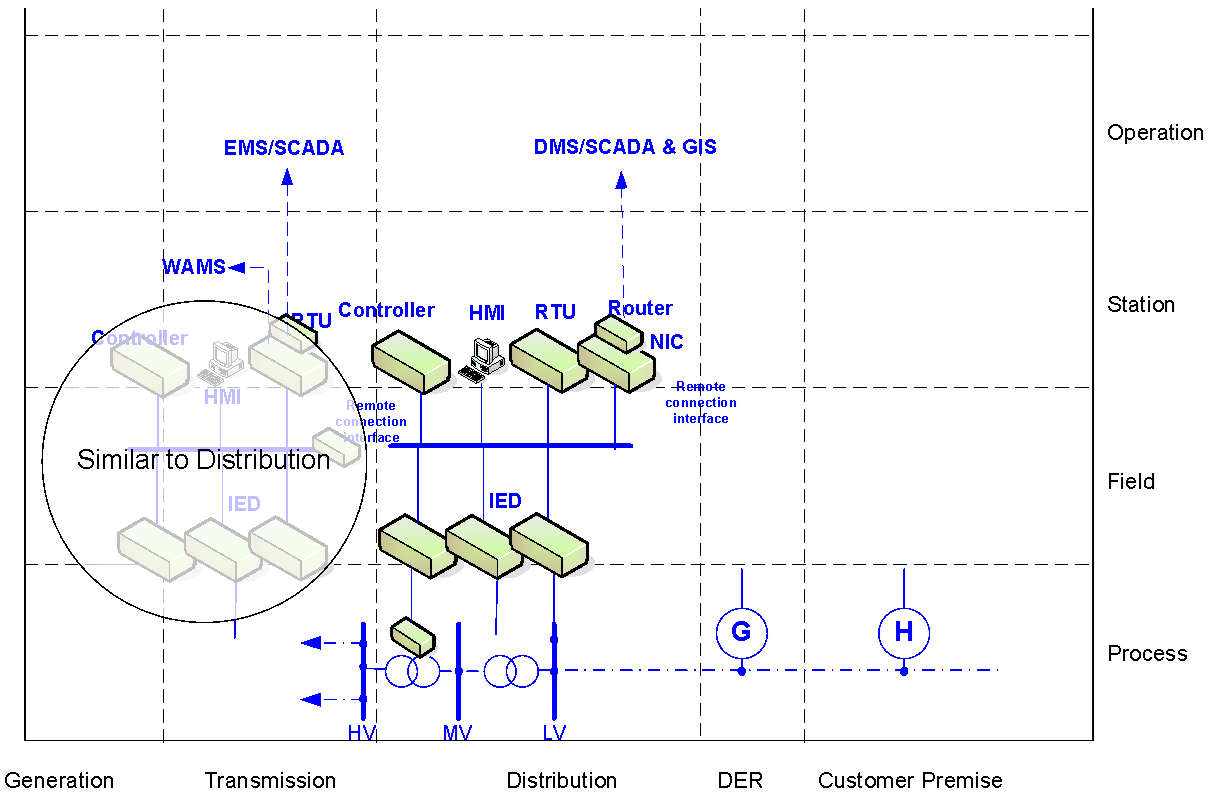
The substation automation component architecture represented in Figure above is mostly made of three zones of components, which may be interconnected through wires or communication.
· The Process zone includes the primary equipment of the substation mainly switching (i.e. circuit-breakers, switches and disconnectors), power transformer regulator and measuring elements (i.e. current and voltage sensors/transformers) including digital sensors.
· The Field zone includes equipment to protect, control and monitor the process of the substation, mainly through IEDs, and controllers. IED
is a generic representation covering components such as (but not limited to):
– Protection
relays or reclosers;
– Operation, Revenue and Grid meters;
– Fault detectors;
– Bay or switch controller;
– Generic I/O interface.
· Field Controller is a generic representation covering components such as (but not limited to):
– Feeder controller (connecting/disconnecting/reclosing sequences);
– Voltage Regulator controller;
– Network Interface Controller (NIC) or Router (remote connection interface sometimes integrated in NIC).
· The Station zone supports the aggregation level which interfaces with other elements and systems of the electrical network. It mostly supports four main technical
functions, which can be grouped or separated in different components:
– RTU which serves as terminal for remote activities, the Station controller, which is in charge of performing automatic functions;
– possibly HMI/archiving which offers the local operators capabilities of visualizing and archiving local data;
– controller such as (but not limited to) a station or feeder controller, or also a capacitor bank controller or a load tap changer controller;
– communication which can be a Network Interface Controller (NIC) and/or just a Router function.
Mapping of standards
on the communication layer
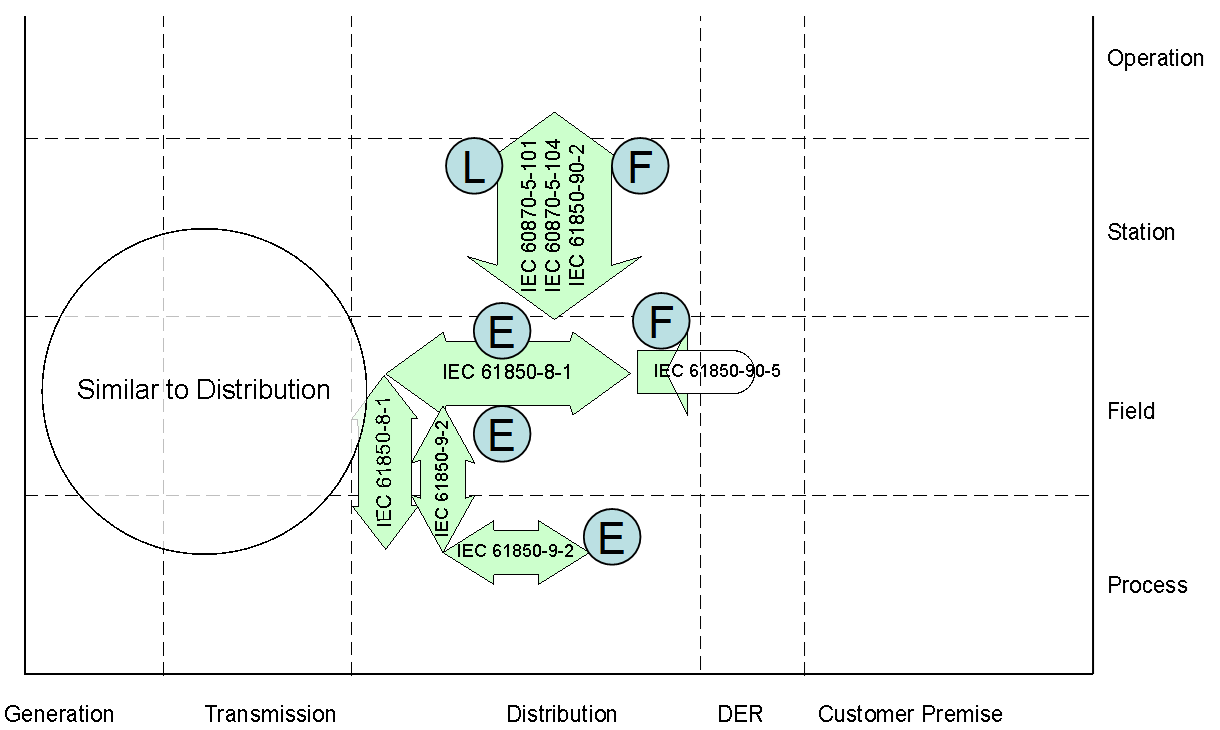
Communication protocols, as presented in the Figure above, can be used either as in a) or b).
a) Within the substation, IEC 61850-8-1 (for any kind of data flows except sample values) and IEC 61850-9-2 (for sample values) are used to support the selected set of System Capabilities.
IEC TR 61850-90-4 provides network engineering guidelines for communication inside a substation (automated MV/LV substations are not really covered yet).
IEC 61850 mostly replaces the former IEC 60870-5-103, used for connecting protection relays.
In the specific case of automated MV/LV substations, communications are more commonly based on industrial networks.
b) Outside the substation, “vertical communications” can rely IEC 60870-5-101 or IEC 60870-5-104, while horizontal communications can rely on IEC TR 61850-90-5 (full mapping over UDP) or IEC TR 61850-90-1 (tunnelling).
Future vertical communication may rely on IEC TR 61850-90-2 (guideline for using IEC 61850 to control centres) and on IEC TR 61850-90-12 (guidelines for using IEC 61850 over WAN) to provide a seamless architecture, based on IEC 61850.
A new mapping of IEC 61850 over the web services technology (IEC 61850-8-2) has been specified, in order to enlarge (in security) the scope of application of IEC 61850 outside the substation, while facilitating its deployment.
Mapping of standards
on the information layer
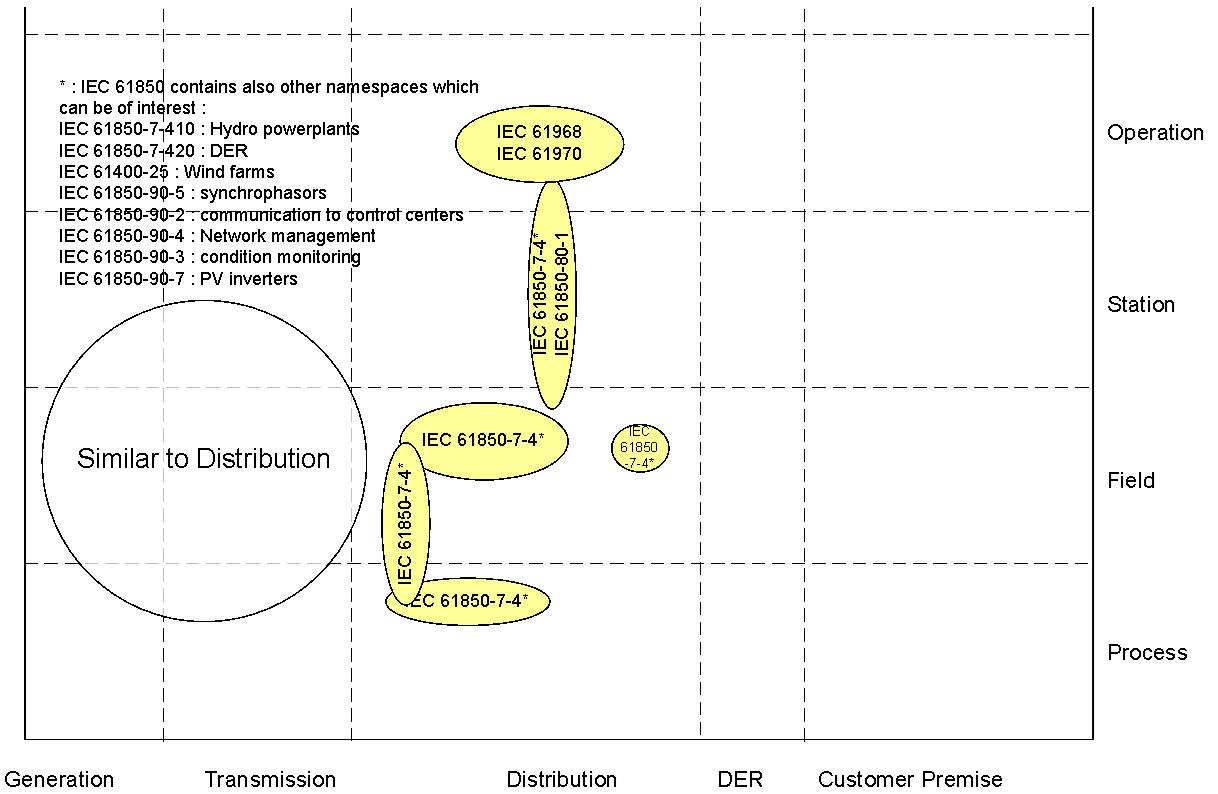
The information layer of substation automation, represented in the Figure above, is mostly based on the IEC 61850 information model.
We have indicated that the IEC 61850-7-4 is the core part depicting this model, however other “namespaces” of the IEC 61850 series can be used such as:
· IEC 61850-7-410:
Hydroelectric power plants
· IEC 61850-7-420: Distributed energy resources (DER) logical nodes
· IEC 61400-25
series: Wind turbine power plants
· IEC TR 61850-90-2: Communication to control centres
· IEC TR
61850-90-3: Condition monitoring
· IEC TR 61850-90-4: Network engineering guidelines
· IEC TR
61850-90-5: Synchrophasors
· IEC TR 61850-90-6; Distribution automation
· IEC TR
61850-90-7: PV inverters – superseded by IEC 61850-7-420
For protocols which are not IEC 61850 native such as the IEC 60870-5-101 or IEC 60870-5-104, a mapping of IEC 61850 information model is possible using the IEC TS 61850-80-1, enabling users of these technologies to use the power of data model driven engineering (and then more seamless integration) without changing of communication technologies.